Attention Residue: A Written Plan Reduced It in Controlled Experiments
Part of your attention stays on the last task. Sophie Leroy's studies show what reduces residue, including a written plan that takes about a minute.
Evidence strength
How confident the science is behind each claim in this article
Some of the students were handed a word puzzle with no solution.
Nobody told them. They worked at it for a few minutes, were told to stop, and were moved straight on to a second job: appraising job candidates from their résumés. Sophie Leroy, the organizational researcher running the experiment, wasn't interested in the puzzle. She wanted to know what was still happening in their heads once they moved on.
What she found was that students who got stuck on the impossible puzzle did worse at the second task than students who had finished a puzzle against the clock. Part of their attention had stayed behind. She named that leftover attention residue.
What attention residue is
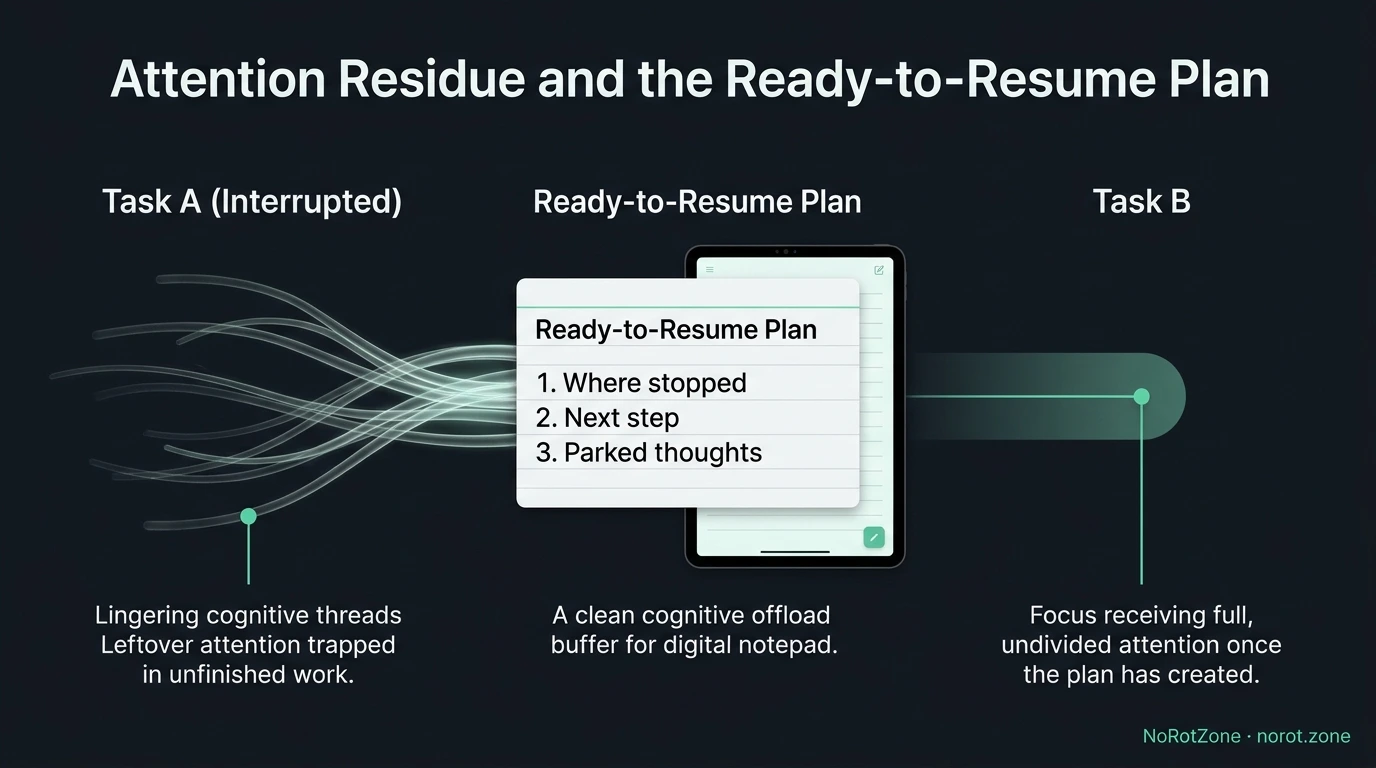
When you switch from Task A to Task B, your attention doesn't move over cleanly. Some of it keeps working on A, so B gets less than you think you're giving it. Picture a browser tab still playing audio after you've clicked away. You aren't looking at it, but it's using the speaker.
You've probably felt it. You leave one meeting still replaying a comment, and the next one starts without you. A message lands mid-document and you reread the same line three times. This is the kind of thing the research was written to explain.
Leroy's 2009 paper ran two experiments, the first with 84 undergraduates, and the pattern was consistent: people found it hard to pull their attention off an unfinished task, and they performed worse on whatever came next.
Finishing helps, but only under a deadline
The obvious fix is to finish what you start. Leroy tested that too, and the answer was more awkward than you'd hope.
People who completed the first task under time pressure showed fewer signs of lingering thoughts and did better on the second task. People who completed it with no time pressure did not get the same release. The deadline group also reported the most confidence that they had really finished. Her explanation is closure: finishing against a tight deadline leaves you sure the job is done, so your attention is free to go.
That is a strange result to build a work week on, and a less useful one than it sounds. Plenty of tasks can't be finished before the next thing lands. Interruptions don't check your progress bar.
A plan beats a deadline
Leroy and Glomb picked up the problem in 2018, in four studies. They found that people who expected to return to an interrupted task under time pressure had a harder time switching, and showed more residue. Then they tested a fix called a ready-to-resume plan.
The plan is small. Before you switch, you briefly write down where you stopped, where you'll pick up, what problems are still open, and what you're parking for later. Leroy says even a minute's work will do.
In their experiments, people who wrote the plan showed less attention residue and did better on the task that interrupted them. Per the University of Washington's summary, they made better decisions and remembered more of the résumés they had just read.
To feel a forced switch first-hand, try Rule Shift, which changes the sorting rule on you mid-run. It trains the switch itself, not the leftover attention this article is about, but the clumsy first answer after a change is a decent place to notice the cost.
What the studies leave open
Treat this as a solid lab result, not a productivity law.
The tasks were short and artificial. The 2009 participants were undergraduates, and the two studies that tested the plan used students too. The researchers also didn't test whether the plan helps when you go back to the original task, so "you'll resume faster" is a reasonable guess, not a finding.
And nobody has handed you a number. These experiments compare conditions. They don't tell you how many minutes residue lasts, so be wary of any article that does.
Using it
When something pulls you off a task, take a minute before you leave:
- Write the sentence that says where you stopped.
- Write the first thing you'll do when you're back.
- Note anything still open or deliberately parked.
You'll find plenty of other advice online: focus blocks, walks between meetings, a ritual to get started. Some of it is sensible. The ready-to-resume plan is the one fix covered here that was tested in lab experiments, so it's the one we can lean on.
The studies were about work interruptions, not phone notifications. The logic carries over to a group chat pinging while you're mid-document, but nobody here tested that.
Unfinished work follows you into whatever you do next. The fix the researchers tested costs a minute of writing.
FAQ
Do I need to finish a task to stop thinking about it?
In Leroy's 2009 experiments, finishing helped mainly when the task was done against a tight deadline. People who finished without time pressure still showed more residue. When finishing isn't possible, a written plan is the fix that was tested.
How long does attention residue last?
The research does not supply a single figure, because the experiments compare conditions instead of timing recovery. Numbers like "23 minutes" that circulate online are not from these experiments.
What goes in a ready-to-resume plan?
The authors describe noting where you stopped, where you'll resume, what challenges remain, and what you're postponing, kept to about a minute.
Sources
- StudyLeroy, S. (2009). Why is it so hard to do my work? The challenge of attention residue when switching between work tasks. Organizational Behavior and Human Decision Processes, 109(2), 168–181.
- StudyLeroy, S., & Glomb, T. M. (2018). Tasks interrupted: How anticipating time pressure on resumption of an interrupted task causes attention residue and low performance on interrupting tasks and how a ready-to-resume plan mitigates the effects. Organization Science, 29(3), 380–397.
Keep Reading
Related Research
Why Multitasking Doesn't Work: The Real Cost of Task-Switching
Multitasking isn't doing two things at once — it's switching between them, badly. Here's what task-switching costs actually do to your brain.
What Is Cognitive Flexibility? The Real Cost of Switching Tasks
The cost of switching tasks, the mental overhead of multitasking, and how to train your brain to adapt.
Neuroplasticity — Your Brain Is Rewriting Itself Right Now
How cognitive challenge supports neural plasticity and engages the brain.
Key Takeaways
- Part of your attention can stay on an unfinished task after you switch away from it.
- In Leroy's 2009 experiments, unfinished tasks led to more lingering thoughts and worse performance on the next task.
- Finishing a task helped mainly when it was done under time pressure.
- A brief written ready-to-resume plan reduced attention residue and protected performance on the interrupting task (Leroy & Glomb, 2018).
- The research used short lab tasks and, in part, student samples, and it gives no recovery time.
Ready to test it?
Rule Shift changes the sorting rule mid-run, so you can feel the cost of a forced switch.
Try Rule Shift: 30 seconds, free, no signup.Published November 4, 2026