Grayscale Mode Cuts Phone Time by 28–38 Minutes a Day, Trials Find
Four trials found grayscale mode cuts phone use by roughly 28 to 38 minutes a day. Here is what that does and doesn't tell us about wellbeing.
Evidence strength
How confident the science is behind each claim in this article
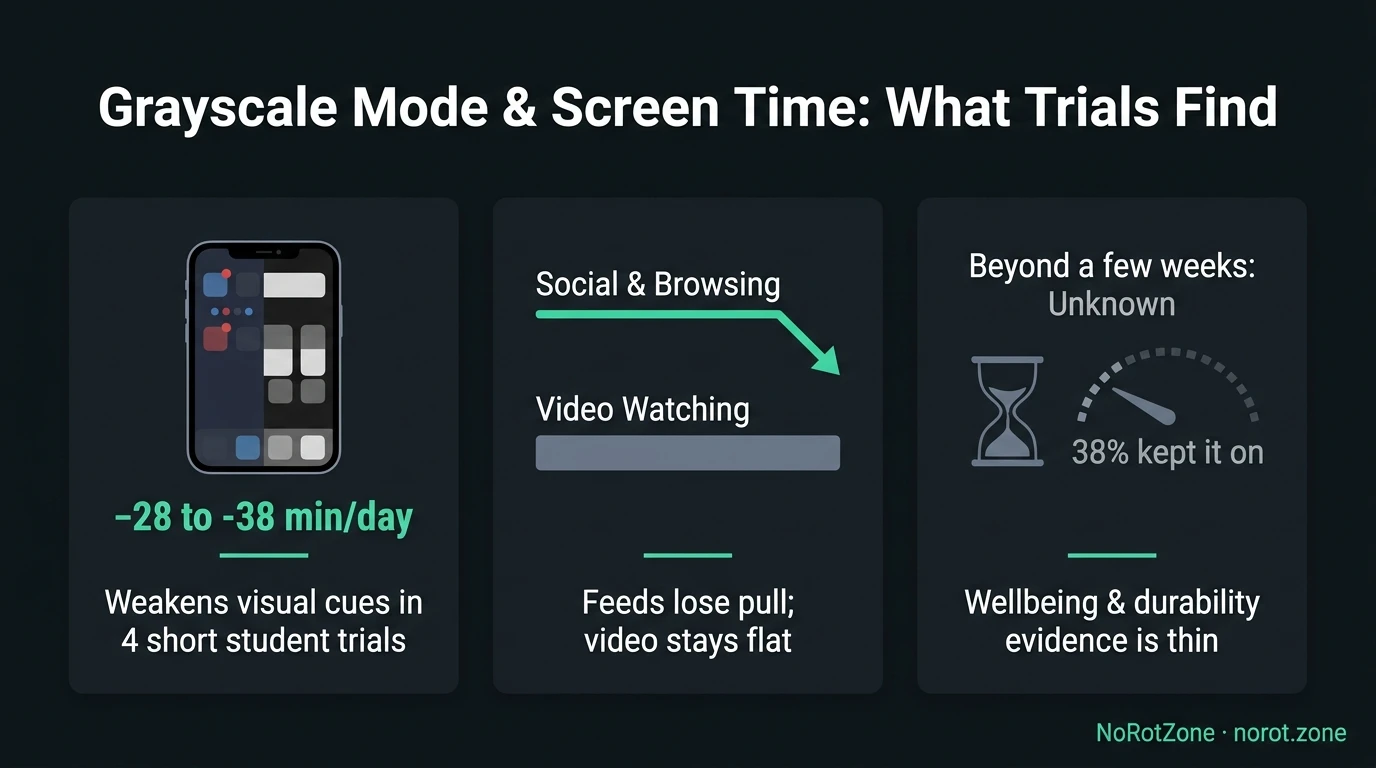
A University of North Dakota team took the colour out of some students’ phones for eight to ten days, then compared screen-time counters with everyone else’s. The grayscale group came out about 38 minutes a day lower. Time spent on video hadn’t moved at all.
That second detail matters more than it looks, and we’ll come back to it. First, the headline number, because four later studies have loosely echoed it.
What the trials found
| Study | Who | Length | Result |
|---|---|---|---|
| Holte & Ferraro (2020) | 161 undergraduates | 8–10 days | About 38 fewer minutes a day. Less social media and browsing, no change in video |
| Holte, Giesen & Ferraro (2023) | 133 college students | Two lab visits | Lower screen time, problematic phone use and anxiety. No change in depression |
| Zimmermann & Sobolev (2023) | 112 students | Several weeks | Immediate drop in objectively measured screen time, larger than from self-set time limits |
| Hagerty et al. (2026) | 51 medical students | One week per condition | About 28 fewer minutes a day, read off the phone’s own counter |
Every sample is students, and the longest follow-up is a few weeks. The newest trial puts the effect in perspective: its colour-week average was just under six hours, so 28 minutes is about 8 percent. A real effect, but a small one.
Where the minutes come from
In the North Dakota study, social media and browsing fell and video didn’t. A film in black and white is still a film, while a feed built from photos and red badges loses more of its pull. That’s a plausible reading, and nobody has tested it.
Substitution is the other open question. In the 2026 trial, one of the ten students who left comments said they simply moved YouTube to a laptop. One anecdote proves nothing, but no trial has tracked what happens to the displaced minutes.
Why it might work, and why nobody has shown it
The usual explanation is that colour makes icons and photos more rewarding, so removing it makes the phone less gratifying. That’s the authors’ interpretation. No trial here measured reward response, so it remains an explanation rather than a finding.
The inhibitory-control angle is the useful one. Habitual unlocking is a response you’d have to stop, and grayscale doesn’t strengthen the stopping. It weakens the cue, so there’s less to stop.
Try the stopping part yourself. Mind Stack is thirty seconds of tapping and not tapping. It won’t rewire your phone habits, because trained inhibition transfers less widely than people hope (our inhibitory control transfer article covers why). It does make the pause concrete.
The wellbeing evidence is thin
Anxiety is where the claims run ahead of the data. In the 2020 study, anxiety and depression improved in both groups, so grayscale couldn’t take the credit. The 2023 study found lower anxiety in the grayscale group, but its authors flagged that the drop may not be clinically meaningful, and depression didn’t change. In the 2026 trial, productivity and sleep showed no consistent difference, measured with survey items the authors hadn’t validated.
If someone says grayscale reduces anxiety, they’re leaning on one study whose own authors hedged it.
Does anyone keep it on?
A McGill team tested a ten-step bundle of phone nudges, grayscale among them, and let students choose which steps to follow. The bundle cut daily screen time by about 1.27 hours in the first study. Grayscale had one of the lowest compliance rates, with 38 percent of that sample keeping it on. Because the steps were bundled, you can’t pull out grayscale’s share of the drop.
No trial has followed grayscale beyond a few weeks, so durability is unknown.
Where that leaves you
Grayscale is a cheap, evidence-backed nudge for screen time, and nothing more has been shown. If you want to try it, it lives in the accessibility settings on both iPhone and Android. Run it for a week and check your own counter against the week before. Treat the result as an experiment on your habits, not a treatment for anything.
FAQ
Does grayscale mode actually reduce screen time?
In short student trials, yes, by about 28 to 38 minutes a day over one to ten days. Whether the effect lasts beyond a few weeks has not been tested.
Does grayscale mode help with anxiety or sleep?
The evidence is thin. One study found lower anxiety that its authors said may not be clinically meaningful, and another found no consistent sleep or productivity differences on unvalidated survey items.
How long does the grayscale effect last?
No trial has followed it beyond a few weeks. In one multi-step study, only 38 percent of participants kept grayscale on.
Sources
- StudyHolte, A. J., & Ferraro, F. R. (2020). True colors: Grayscale setting reduces screen time in college students. The Social Science Journal.
- StudyHolte, A. J., Giesen, D. T., & Ferraro, F. R. (2023). Color me calm: Grayscale phone setting reduces anxiety and problematic smartphone use. Current Psychology, 42, 6778–6790.
- StudyZimmermann, L., & Sobolev, M. (2023). Digital strategies for screen time reduction: A randomized field experiment. Cyberpsychology, Behavior, and Social Networking, 26(1), 42–49.
- StudyOlson, J. A., Sandra, D. A., Chmoulevitch, D., Raz, A., & Veissière, S. P. L. (2022). A nudge-based intervention to reduce problematic smartphone use: Randomised controlled trial. International Journal of Mental Health and Addiction.
- StudyHagerty, J., Saretha, S., Phung, B., Le, V., Vargas, J., Khan, F., & Wright, D. (2026). A cross-over feasibility trial of smartphone grayscale mode in medical students. Frontiers in Digital Health, 8, 1816095.
Keep Reading
Related Research
Stop-and-Think Training Raised Science Scores, Not General Self-Control
A large randomized trial trained UK primary schoolers to "stop and think." It worked — but the skill stayed put, right where it was trained.
What Is Inhibitory Control? The Science of Resisting Your Own Impulses
The brain system that stops you acting on impulse, why it's a core executive function, and how to train it.
Dopamine — The Chemical That's Driving Your Brain Rot
Why your brain craves brain rot content and how to rewire the reward loop.
Key Takeaways
- Across four small student trials, grayscale mode cut daily phone time by roughly 28 to 38 minutes.
- In the one study that checked, the drop came from social media and browsing. Video time didn't change.
- Evidence for benefits to anxiety, sleep or productivity is thin and inconsistent.
- No trial has followed grayscale beyond a few weeks, and in one study only 38 percent of participants kept it on.
Ready to test it?
Mind Stack has you tap, then stop on a hazard, a quick feel for the pause that breaking a habit takes.
Try Mind Stack: 30 seconds, free, no signup.Published November 19, 2026