Stop-and-Think Training Raised Science Scores, Not General Self-Control
A large randomized trial trained UK primary schoolers to "stop and think" before answering science questions. It worked — but the skill stayed put, right where it was trained.
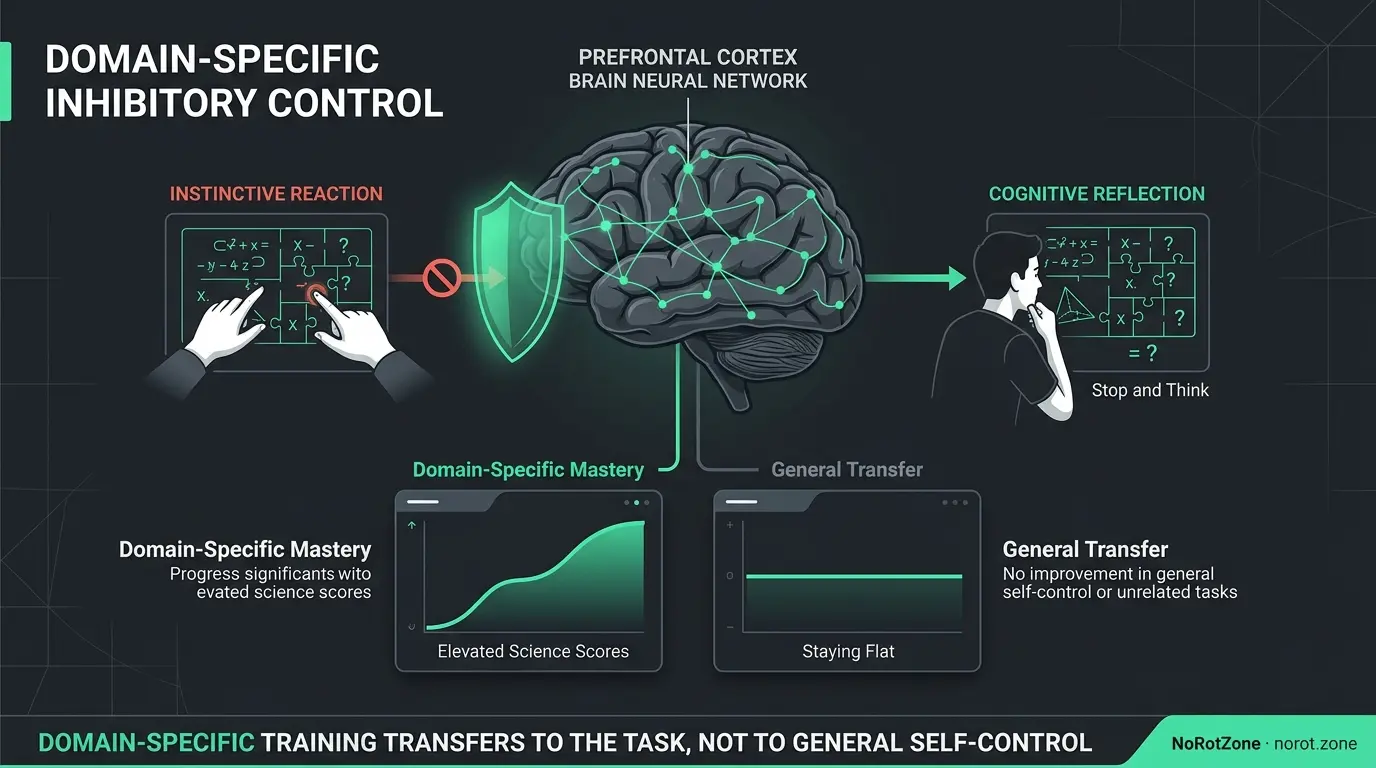
"Brain training doesn't transfer" is close to a settled fact in cognitive science by now. Train someone on a memory game and their memory game score goes up; their actual, real-world memory mostly doesn't. It's one of the more deflating findings in the field, and we don't pretend otherwise. But a trial out of the UK found something narrower and more interesting: inhibitory control training that stayed inside one academic domain transferred to that domain, while leaving general inhibitory control completely untouched.
The program
Researchers at Birkbeck, University of London and UCL's Institute of Education, working through the Centre for Educational Neuroscience, built a computer program called Stop and Think, funded by the Education Endowment Foundation and Wellcome. It ran 12-minute sessions over 10 weeks with 7- to 10-year-olds, using multiple-choice science and maths questions designed to trigger an obvious-but-wrong first instinct. The training asked pupils to notice that instinct, override it, and give a more considered answer instead — inhibitory control applied directly to counterintuitive schoolwork, not a stop-signal task dressed up as a game.
What it actually changed
The first trial ran across 89 schools and 6,672 pupils. Compared to classes taught as usual, pupils using Stop and Think made the equivalent of two additional months' progress in science and one additional month in maths. A second, larger effectiveness trial mostly confirmed the science result. The maths gain disappeared at scale — pupils eligible for free school meals showed no extra progress in maths compared to the control group, even as the science effect held.
Mind Stack trains the same instinct-override reflex this trial measured — 30 seconds, free, no signup.
The honest part
The researchers also measured general inhibitory control directly, separate from the academic tests, and found no improvement there at all. Ten weeks of training kids to override their instinct on science questions made them better at overriding their instinct on science questions. It didn't make them generally better at self-control, impulse regulation, or inhibiting responses in unrelated situations.
What domain-bound transfer actually tells you
Training that stays close to the task builds a real, usable skill — just not a portable one. The effect showed up specifically where the training happened, which cuts against the common shorthand that "brain training doesn't transfer." That critique is really a critique of general transfer. It says nothing about whether targeted training does anything at all. Practice within the domain you actually want to improve beats practice on an abstract proxy for it: if you want better judgment under pressure on a specific task, training that task gets you closer than training an unrelated inhibition exercise and hoping it carries over.
That's the practical case for something like Mind Stack: repeated practice inside the same stop-and-override move you're trying to build, rather than a bet that a disconnected exercise will quietly generalize elsewhere. For the general mechanics of what inhibitory control is and why it matters, see our piece on inhibitory control.
FAQ
Doesn't this just prove brain training doesn't work?
It proves the opposite for training that stays close to the task — pupils genuinely got better at overriding instinct on science questions. What it argues against is the idea that any single narrow exercise will generalize into general-purpose self-control.
Why did the science result hold up but the maths result didn't?
Researchers pointed partly to how maths is already taught — techniques like using "non-examples" may already train similar reasoning, leaving less room for an added effect. Science teaching used fewer of those techniques, giving Stop and Think more room to help.
What age group was this study conducted on?
UK primary schoolers in Year 3 and Year 5, ages 7 to 10, though the underlying mechanism isn't specific to children.
Sources
- StudyWilkinson, H.R., Smid, C., Morris, S., Farran, E.K., Dumontheil, I., Mayer, S. et al. (2019). Domain-specific inhibitory control training to improve children's learning of counterintuitive concepts in Mathematics and Science. Journal of Cognitive Enhancement, 4, 296–314.
- StudyRoy, P., Rutt, S., Easton, C., Sims, D., Bradshaw, S. & McNamara, S. (2019). Stop and Think: Learning Counterintuitive Concepts. Education Endowment Foundation evaluation report.
Related Research
What Is Inhibitory Control? The Science of Resisting Your Own Impulses
The brain system that stops you acting on impulse, why it's a core executive function, and how to train it.
Dopamine — The Chemical That's Driving Your Brain Rot
Why your brain craves brain rot content and how to rewire the reward loop.
EEG Shows the Brain Plans Your Next Move the Moment a Memory Forms
EEG evidence shows the brain begins planning a specific physical action the instant relevant information enters working memory — not later, when it's needed.
Key Takeaways
- A randomized trial of 6,672 pupils across 89 UK schools found a "Stop and Think" program improved science scores by the equivalent of two months' extra progress.
- The same trial found one extra month of maths progress, but a larger follow-up trial found the maths effect disappeared at scale.
- Crucially, general inhibitory control — measured separately from the academic tests — did not improve at all.
- The training worked by getting specific to the domain it was practiced in, not by building a portable, general-purpose skill.
- This is a case for domain-embedded practice over abstract inhibition drills that hope to transfer elsewhere.
Ready to test it?
Practice the stop-and-override move in Mind Stack — 30 seconds, free, no signup.
Practice the stop-and-override move in Mind Stack — 30 seconds, free, no signup.Published August 10, 2026