What Is Attention? The Neuroscience of Focus and How to Train It
Attention isn't just willpower — it's a trainable cognitive system. Learn how sustained attention works, why it degrades, and how short-burst games can sharpen it.
Let's be honest. You've probably noticed it yourself.
A book you used to finish in a weekend now takes three weeks. You open a browser tab with a purpose and thirty seconds later you're somewhere else entirely, with no memory of deciding to go there. You sit down to do something that requires actual thinking and your brain immediately starts looking for an exit.
This isn't a character flaw. It's what happens to an attentional system that's been fed a diet of instant, frictionless stimulation for years. Your attention isn't broken — it's just been badly trained.
What attention actually is (and isn't)
Attention is your brain's selection system. At any given moment, far more information is hitting your senses than your brain can consciously process — your visual cortex alone receives input from roughly a million optic nerve fibres simultaneously. Attention is the filter that decides what gets through.
There's a common misconception that attention is about willpower. It isn't. It's a neurological resource, managed primarily by the prefrontal cortex and the parietal lobe, and like any resource, it's finite, it fatigues, and it responds to training.
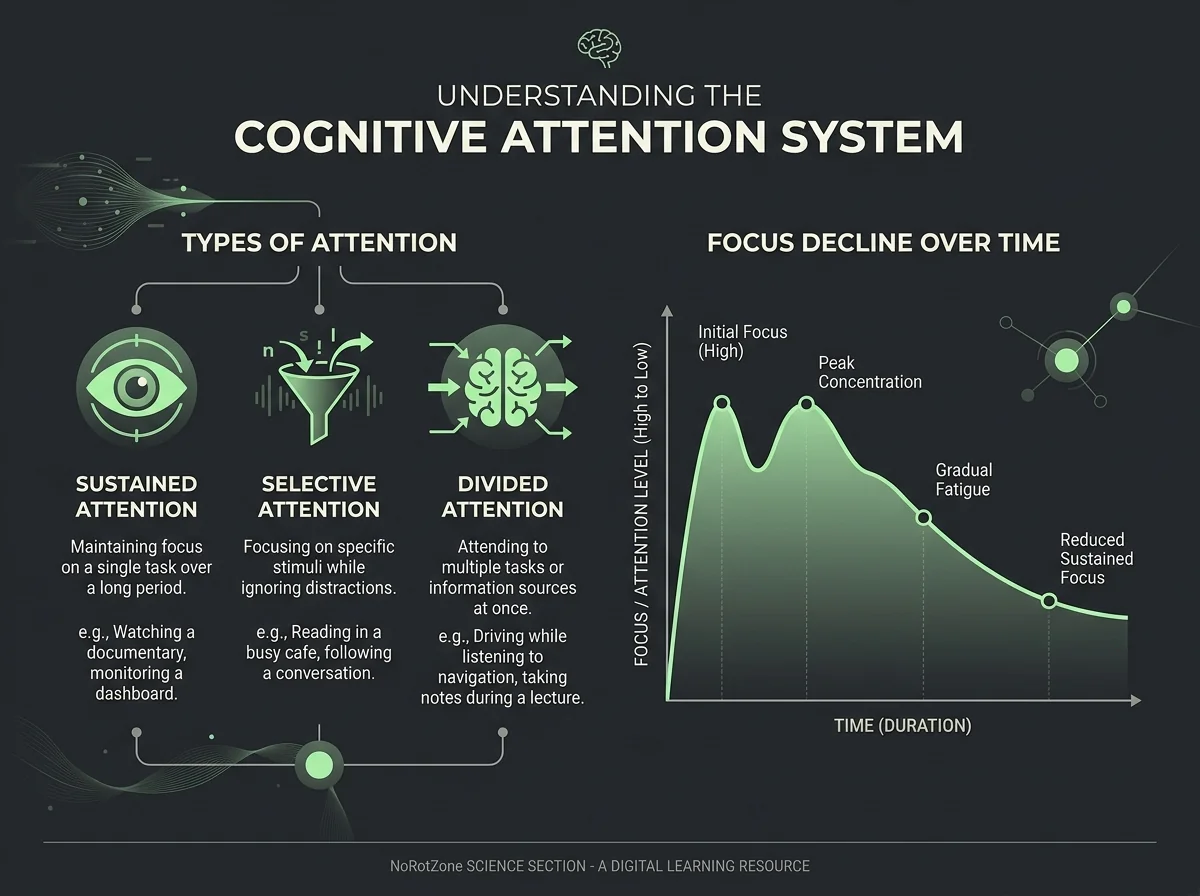
There are also different types, and this distinction matters more than most people realise:
Selective Attention
The ability to focus on one thing while filtering out everything else. Reading in a noisy room. Following one conversation at a party. Your brain's noise-cancelling mode.
Sustained Attention
Also called vigilance — the ability to maintain focus over time. It's the one that degrades first, and the one most relevant to why you feel mentally foggy by 3pm.
Divided Attention
Tracking multiple things at once. It's rarer, more expensive, and what most people call "multitasking" isn't actually this — it's rapid switching between tasks, which carries a real cognitive cost each time.
The vigilance problem
Here's a number worth knowing: sustained attention performance starts to noticeably decline after around 20 minutes on a continuous task. This was first documented in World War II radar operators who were asked to monitor screens for hours at a time — their miss rates climbed steadily as the session wore on. The phenomenon is called the vigilance decrement, and it hasn't changed because brains haven't changed.
What has changed is the environment those brains are operating in.
Social media platforms, notification systems, and content feeds are engineered around a quirk in how attention works: your brain has an involuntary orienting response to novel, high-contrast, or emotionally charged stimuli. Something moves at the edge of your vision, you look. Something pings, you check. This is automatic — it evolved to keep you alive, not to help you finish your work.
Modern technology turned this reflex into a business model. And the result, after years of high-stimulation, low-demand content, is that the threshold for "interesting enough to pay attention to" keeps creeping upward — making anything that requires sustained effort progressively harder to start, and harder to stick with.
What's actually happening in your brain
Two neurotransmitters do most of the heavy lifting when it comes to attention.
Acetylcholine — The Spotlight
Directs your focus — it highlights the specific neurons that should be active, essentially pointing your cognitive spotlight at whatever you're trying to attend to. When it's flowing, information gets in. When it isn't, things slide past without registering.
Dopamine + Norepinephrine — The Signal
Work together to regulate the signal-to-noise ratio in your prefrontal cortex. Dopamine reduces the background noise — the mental chatter competing for attention. Norepinephrine boosts the signal — the thing you're actually supposed to be focused on. Together, they're what focus feels like from the inside.
The prefrontal cortex, which orchestrates all of this, is also metabolically expensive to run. Sustained cognitive effort depletes its resources faster than passive activity — which is why genuine mental work feels tiring in a way that scrolling doesn't, even when scrolling takes up more of your time.
The attention-stimulation trap
Here's the uncomfortable part. Your brain doesn't distinguish between "productive stimulation" and "junk stimulation" in the moment — it just responds to stimulation levels. High stimulation triggers engagement. Low stimulation triggers restlessness.
After years of high-stimulation passive content, the brain recalibrates. Its baseline for "interesting enough to engage with" shifts upward. A page of text, a conversation without a phone nearby, a task without a progress bar — these start to feel genuinely uncomfortable. Not because they're difficult, but because they're not hitting the stimulation threshold your brain has learned to expect.
This is why "just focus harder" doesn't fix it. You can't willpower your way out of a recalibrated baseline. You have to gradually shift it back — which requires consistent practice with tasks that make genuine demands on your attentional system, not just more time spent trying to concentrate on things your brain has learned to resist.
Focus Run is designed to support active attentional control under pressure.
What supports attention
The research here is more honest than most productivity content gives it credit for. Attention is trainable — but the mechanism matters.
Sleep is the biggest single lever. Sustained attention is one of the first cognitive functions to degrade under sleep restriction, and one of the last to recover. If you're regularly running on six hours, everything else you try is fighting uphill.
Short, high-demand sessions are key. The key word is demand. Passive exposure — even to educational content — doesn't engage attentional control the way active, effortful tasks do. Your brain needs to be doing the selecting, filtering, and deciding. Not just receiving.
Deliberate rest actually counts. After a focused session, the right recovery isn't more stimulation — it's genuine low-stimulation downtime. Not checking your phone. Not switching to another screen. Your prefrontal cortex needs recovery time, not a different kind of load.
Consistency beats intensity. Regular short practice on tasks that require attentional control is a great way to stay sharp. This is the whole premise behind 30-second cognitive games — the value isn't in any single session. It's in the accumulation of reps over time.
Swap the scroll, not all screen time. The issue isn't screens. It's high-stimulation, zero-demand screen use. Replacing five minutes of passive feed-scrolling with one round of a game that requires active focus is a directional change that — over time — supports your focus systems.
FAQ
Why is my attention span getting worse?
It's likely not getting worse in a fixed, permanent sense — your baseline for what counts as "stimulating enough" has shifted after years of high-stimulation content, which makes slower-paced tasks feel harder to start, not impossible.
How long can you actually focus before attention drops off?
Research on sustained attention has found performance reliably starts declining after roughly 20 minutes on a continuous task — a pattern first documented in WWII radar operators and still consistent today.
Does multitasking actually work?
Not in the way most people think. What feels like multitasking is usually rapid switching between tasks, and each switch carries a real cognitive cost — it's not true simultaneous processing.
Related Research
Doomscroll Brain: What Short-Form Video Does to Your Attention
TikTok-style scrolling isn't just a habit — it's a measurable attention effect. Here's what the research actually shows.
What Is Brain Rot, Actually?
Oxford's 2024 Word of the Year — but is it real? Discover the actual cognitive studies and what the science says.
Cortisol — The Stress Hormone That's Running Your Day
Why chronic low-grade stress runs your day, and how doomscrolling flatlines your focus.
Key Takeaways
- Attention is a finite neurological resource managed by the prefrontal cortex — not a personality trait or a willpower problem.
- Sustained attention starts to decline after around 20 minutes of continuous focus — this is normal and well-documented (vigilance decrement).
- Acetylcholine directs focus; dopamine and norepinephrine regulate the signal-to-noise ratio that makes concentration possible.
- Years of high-stimulation, low-demand content raises the brain's engagement threshold — making effortful tasks feel harder to start.
- Short, high-demand practice sessions are designed to engage attentional capacity more effectively than long, low-demand ones.
Ready to test it?
Put the theory into practice. Break the passive loop with 30 seconds of high-intensity focus training.
Train Your AttentionPublished April 11, 2026