Predictable Timing Alone Sharpens Visual Detection, Oxford Study Finds
When events follow a predictable rhythm, the brain synchronizes sensory cortex to peak at the expected moment — making faint signals easier to detect.
Evidence strength
How confident the science is behind each claim in this article
Psychologists have used roughly the same metaphor for attention since the 1980s: a spotlight that swings across space, brightening whatever it lands on. It's a good metaphor, as far as it goes. It just leaves out an entire dimension. The spotlight doesn't only move across space. It also moves through time.
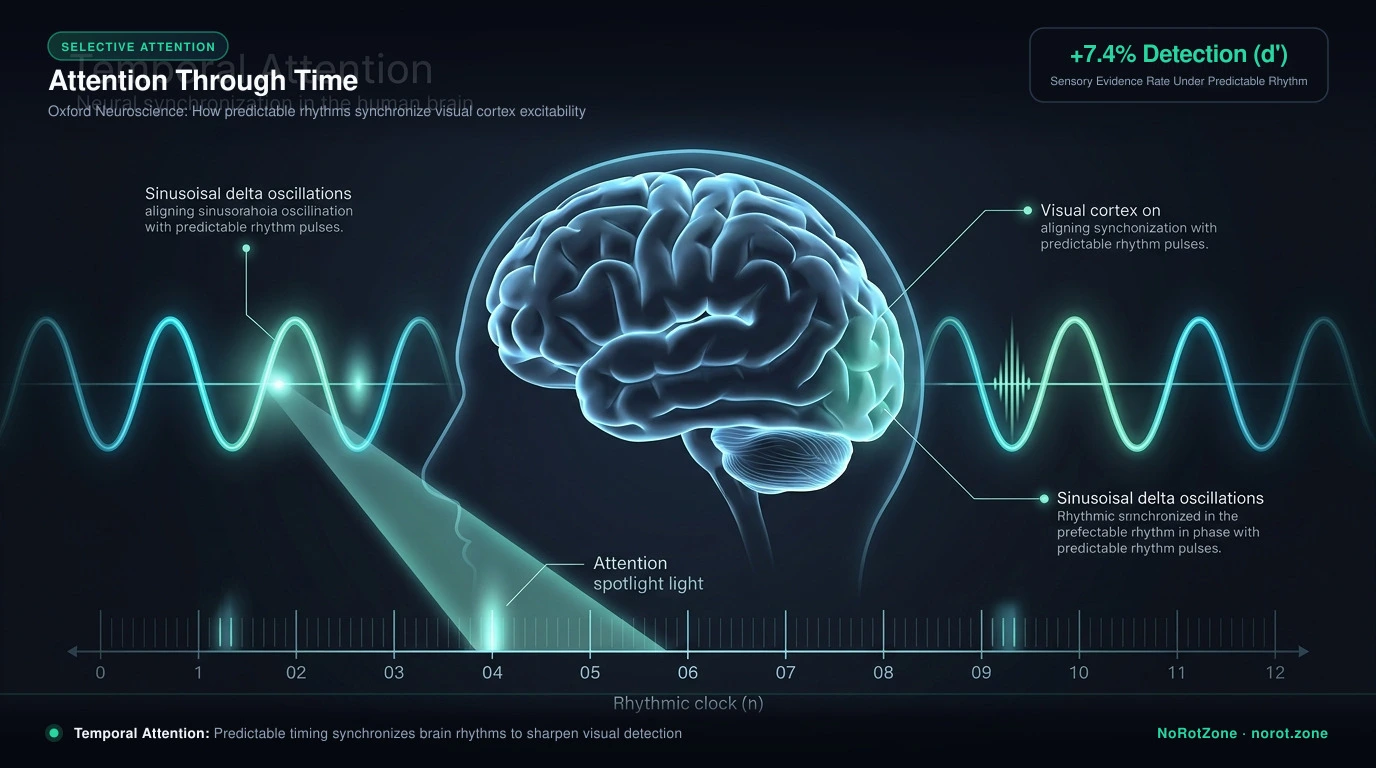
A spotlight that also tells time
Attention doesn't just pick a place to focus. It can also pick a moment. When events follow any kind of learnable pattern — a steady rhythm, a probability, a habitual timing — the brain appears to anticipate when the next relevant thing will happen and sharpen perception right around that instant. Anna Nobre and Freek van Ede's 2018 review in Nature Reviews Neuroscience, "Anticipated moments," makes the case that this temporal structure in attention deserves the same serious study as its spatial counterpart.
Proving it in the lab
A 2012 study from Nobre's group at Oxford put this to a direct test. Participants watched a rapid stream of visual noise patches, occasionally containing a faint tilted target, arriving either at a fixed 400-millisecond rhythm or at irregular, jittered intervals. Detecting the target got measurably easier under the rhythmic condition: discriminability rose from an average of 1.35 to 1.45, and reaction times dropped, purely from knowing roughly when the next target was due. A computational model of the decision process traced the improvement to an increase in the rate at which sensory evidence accumulated toward a decision, not a change in strategy or a lowered response threshold. Predictable timing wasn't making people guess faster. It was making the signal itself easier to read.
Spot the Odd trains fast detection under a ticking clock — 30 seconds, free, no signup.
How the brain does the counting
A follow-up study from the same group found a plausible mechanism. Low-frequency oscillations in visual cortex, in the delta range, shift their phase to line up with a predictable rhythm, so that the brain's moment of peak excitability arrives right when a relevant event is expected. The "counting" isn't a metaphor. It's a literal, measurable synchronization between brain rhythms and the timing of the outside world.
Beyond a simple beat
Nobre's 2024 Cognitive Neuroscience Society award lecture, "Focus through Time," extended this well past simple rhythms. Her group's broader argument is that attention draws on a wide range of temporal structures — learned associations, probabilities, and sequences extracted over both short delays and long-term memory — to anticipate relevant moments in far messier, real-world settings than a lab stream of noise patches. The spotlight isn't just moving. It's been trained on a schedule.
Reaction-time research measures how fast you respond once something appears. This is a step earlier: it's about the brain narrowing when it expects to need to respond at all, before anything has appeared yet. For more on the speed side of that equation, see our piece on reaction time.
FAQ
How is temporal attention different from standard spatial attention?
Spatial attention acts like a spotlight deciding where to focus mental resources across space, while temporal attention decides when to sharpen sensory processing in time. Both can operate independently or reinforce each other.
Does predictable timing actually change what the eyes see, or just how fast you click?
It changes the quality of sensory evidence itself. Drift-diffusion modeling confirmed that rhythmic timing increased the evidence accumulation rate rather than lowering the threshold needed to hit a key.
How does the brain sync with external rhythms?
Visual cortex delta-band oscillations shift their phase so that the most excitable phase of the wave lines up with the anticipated arrival time of the stimulus, a process known as phase entrainment.
Sources
- StudyRohenkohl, G., Cravo, A. M., Wyart, V., & Nobre, A. C. (2012). Temporal expectation improves the quality of sensory information. Journal of Neuroscience, 32(24), 8424–8428.
- StudyCravo, A. M., Rohenkohl, G., Wyart, V., & Nobre, A. C. (2013). Temporal expectation enhances contrast sensitivity by phase entrainment of low-frequency oscillations in visual cortex. Journal of Neuroscience, 33(9), 4002–4010.
- StudyNobre, A. C., & van Ede, F. (2018). Anticipated moments: Temporal structure in attention. Nature Reviews Neuroscience, 19(1), 34–48.
Keep Reading
Related Research
Doomscroll Brain: What Short-Form Video Does to Your Attention
TikTok-style scrolling isn't just a habit — it's a measurable attention effect. Here's what the research actually shows.
What Is Brain Rot, Actually?
Oxford's 2024 Word of the Year — but is it real? Discover the actual cognitive studies and what the science says.
What Is Attention? The Neuroscience of Focus and How to Train It
Why your focus is broken, what the 'vigilance decrement' is, and how to train your attention systems.
Key Takeaways
- A 2012 Oxford study found that knowing when a visual target would appear improved discriminability (d' rose from 1.35 to 1.45) and reduced reaction times, without changing decision bias or response thresholds.
- Computational drift-diffusion modeling showed predictable timing increases the rate at which sensory evidence accumulates, sharpening the perceived signal rather than just prompting faster guesses.
- Follow-up EEG research revealed the mechanism: low-frequency delta oscillations in the visual cortex align their phase to external rhythms, placing peak neural excitability exactly at the expected moment.
- Temporal attention is not limited to simple metronomes — the brain leverages learned associations, statistical regularities, and memory to anticipate critical moments across complex everyday tasks.
- While reaction time measures speed after a stimulus appears, temporal attention prepares the sensory cortex beforehand, narrowing the window where processing capacity is focused.
Ready to test it?
Test your visual detection under pressure in Spot the Odd — 30 seconds, free, no signup.
Test your visual detection under pressure in Spot the Odd — 30 seconds, free, no signup.Published October 14, 2026