One Bad Night's Sleep Cuts New Memory Formation by 40%
A single night without sleep reduces the brain's ability to form new memories by 40%. Here's the two-stage science of how sleep protects memory, before you learn and after.
You pull the all-nighter, walk into the exam running on adrenaline and coffee, and somehow still remember most of it. You conclude you got away with it. You didn't — the damage just wasn't done to that memory. It was done to the ones you were supposed to form next.
Sleep researchers, including Matthew Walker's lab at UC Berkeley, treat sleep and memory as a two-stage relationship rather than one vague "rest" function. Sleep does one job before you learn something and a different job entirely after. Skip it on either side and you lose something different each time.
Before you learn: sleep loss blocks the hippocampus
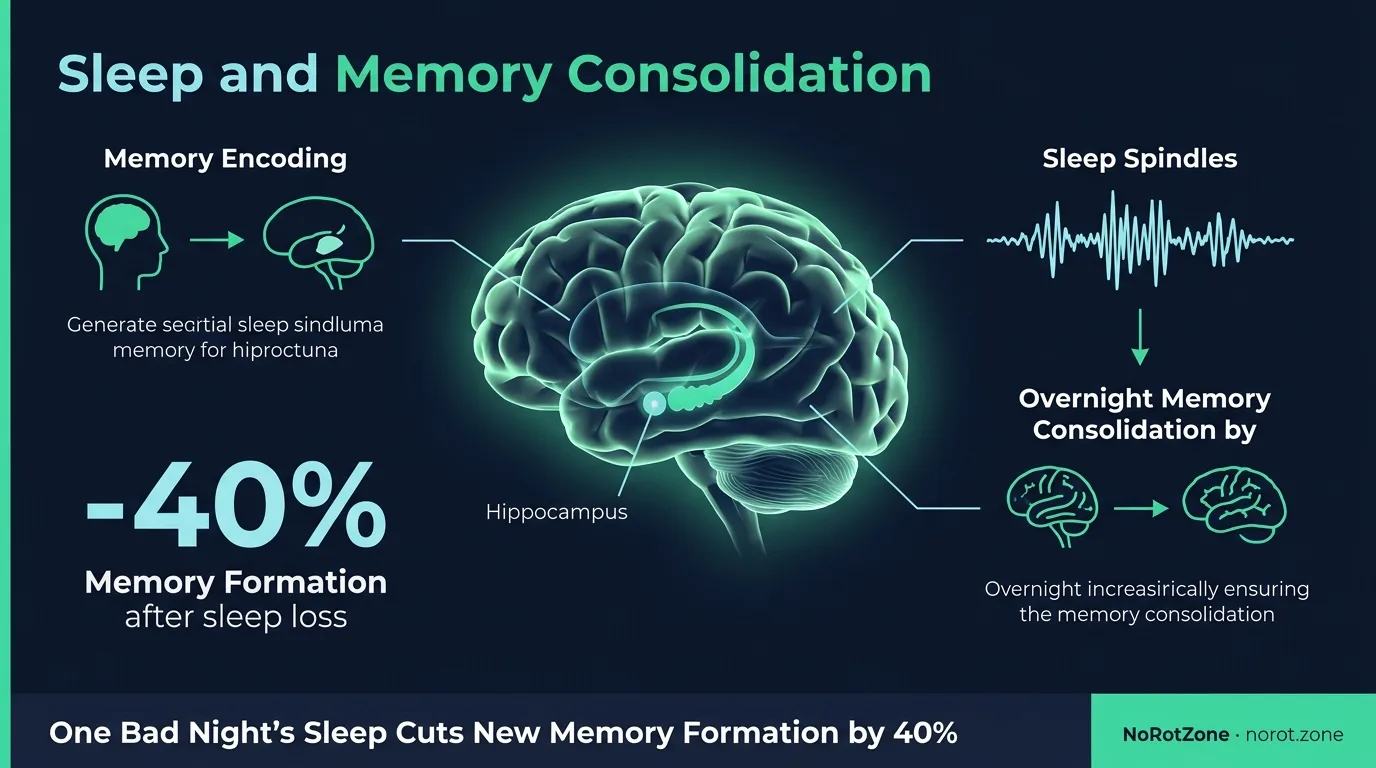
In a 2007 study published in Nature Neuroscience, Yoo and colleagues put participants through a full night of sleep deprivation, then had them try to encode new visual memories the next day inside an MRI scanner. Compared to a group that slept normally, the sleep-deprived group showed a 40% reduction in their ability to form new memories — and the deficit showed up as reduced activity specifically in the posterior hippocampus, the region most responsible for turning experience into memory.
This is the part most people miss about pulling an all-nighter before a big day. It's less about being tired during the event and more about what your brain failed to encode in the days beforehand, because it never got the sleep it needed to lay that groundwork in the first place.
Buffer trains the same encoding system this research is talking about — 30 seconds, free, no signup.
After you learn: sleep files it away
The other half of the story is older. In 1924, Jenkins and Dallenbach ran a small but influential study: participants learned lists of nonsense syllables, then either slept or stayed awake through the retention interval before being tested. Forgetting during wakefulness was steep and steady. Forgetting during sleep nearly flattened out. Their explanation was interference — no new experiences competing for the same mental space.
Modern sleep labs found a more active mechanism sitting underneath that old finding. In studies from Gais, Born, and Schabus, participants who learned word pairs before bed showed a measurable increase in sleep spindles — brief bursts of 12–16Hz brain activity during non-REM sleep — compared to a control night with no learning task. The people whose spindle activity increased the most also showed the biggest overnight improvement on the word-pair test the next morning. The leading theory is that spindles reflect a dialogue between the hippocampus, where memories form, and the cortex, where they get filed away for longer-term storage.
What actually moves the needle
None of this means one rough night ruins your memory permanently. It means the timing of sleep loss changes what you lose. Skip sleep before you need to learn something and you're handicapping the encoding itself. Skip sleep after you've learned it and you're interrupting the filing process, so the memory stays fragile the next day. Adults generally need somewhere around 7 to 9 hours to give both processes room to work, and there's no real substitute for it. Naps, caffeine, and force of will can paper over the fatigue. They can't recreate the spindle activity your brain generates specifically during a full night's sleep.
Recovery sleep restores your ability to encode new memories going forward. It doesn't reach back and fix the one you failed to form the night you skipped. For the other side of what sleep loss does to your brain, see our piece on cortisol — chronic sleep debt keeps that system elevated too.
FAQ
Does a nap help the same way a full night's sleep does?
A nap that includes non-REM sleep and spindle activity can support consolidation, but a full night gives the process far more time to run — naps are a partial substitute, not a full one.
How soon after learning something does the sleep need to happen?
Same-night sleep is what the research generally tests, and the original interference explanation suggests sooner is better — every waking hour in between gives new information a chance to compete with what you just learned.
Can you catch up on missed sleep and get the memory back?
Recovery sleep restores your brain's ability to encode new memories going forward, but it doesn't retroactively reconstruct a memory that failed to form or consolidate on the specific night you missed it.
Sources
- StudyYoo, S.S., Hu, P.T., Gujar, N., Jolesz, F.A. & Walker, M.P. (2007). A deficit in the ability to form new human memories without sleep. Nature Neuroscience, 10, 385–392.
- StudyJenkins, J.G. & Dallenbach, K.M. (1924). Obliviscence during sleep and waking. American Journal of Psychology, 35(4), 605–612.
Related Research
EEG Shows the Brain Plans Your Next Move the Moment a Memory Forms
EEG evidence shows the brain begins planning a specific physical action the instant relevant information enters working memory — not later, when it's needed.
One Year of Walking Grew Older Adults' Hippocampus by 2%, One Trial Found
A randomized trial found aerobic exercise grew the hippocampus 2% in a year, reversing age-related shrinkage. Here's the study.
SuperAgers: The 80-Year-Olds Whose Memory Rivals People 30 Years Younger
SuperAgers score like people 30 years younger on memory tests. 25 years of brain research shows why — and it's not diet or exercise.
Key Takeaways
- A 2007 study found one night of sleep deprivation cut the brain's ability to form new memories by 40%, with reduced activity in the posterior hippocampus.
- A classic 1924 study found forgetting during wakefulness is steep and steady, while forgetting during sleep nearly flattens out.
- Sleep spindles — brief bursts of brain activity during non-REM sleep — increase after learning, and more spindle activity predicts better overnight memory retention.
- Sleep does two separate jobs: protecting your ability to encode memories before you learn, and consolidating them after.
- Recovery sleep restores future encoding ability, but it doesn't retroactively fix a memory that failed to form the night you missed sleep.
Ready to test it?
Put your working memory to work in Buffer — 30 seconds, free, no signup.
Put your working memory to work in Buffer — 30 seconds, free, no signup.Published August 6, 2026