EEG Shows the Brain Plans Your Next Move the Moment a Memory Forms
EEG evidence shows the brain begins planning a specific physical action the instant relevant information enters working memory — not later, when it's needed.
What's the point of remembering something if you have no plan to use it? For decades, working memory research quietly treated those as two separate steps: first you hold information in mind, then, separately, later, you decide what to do with it. Recent EEG work suggests the brain doesn't actually wait that long.
Attention that points inward, not just outward
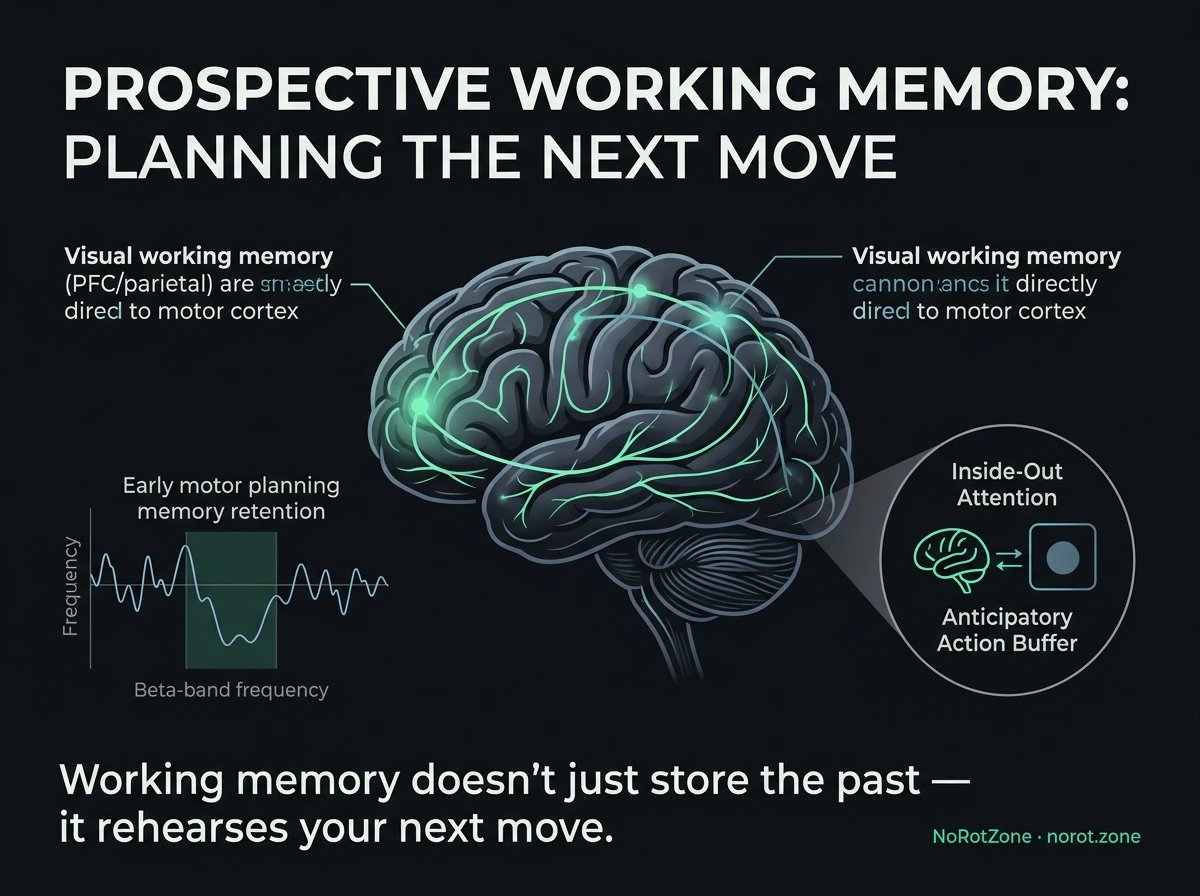
Most attention research is about the outside world: what you look at, what you tune out. But your own memory needs the same kind of prioritizing once information is already in your head, deciding which held item matters most right now. Freek van Ede and Anna Nobre's 2023 review in Annual Review of Psychology calls this "inside-out" attention, and argues it's just as functional and future-focused as the outside-in kind. Their example is a familiar one: check your mirrors while driving, hold what you saw in mind, then use it seconds later to decide whether it's safe to change lanes. Working memory isn't preserving the mirror check for its own sake. It's keeping it around because you're about to act on it.
Buffer trains working memory the way it's actually used — 30 seconds, free, no signup.
What the brain does the moment a memory forms
A 2023 study from van Ede's lab, published in the Journal of Neuroscience, tested this directly. Participants held one or two tilted bars in memory, each bar's tilt linked to a specific button-press they'd need to make later. Using EEG, the researchers tracked a well-established signature of motor planning: a dip in beta-band activity over the motor cortex tied to the responding hand. That dip showed up almost immediately after a bar was encoded into memory, well before the button press was actually needed. The brain wasn't just storing what the bar looked like. It was already rehearsing what to do about it.
The planning happens even when the action isn't certain
The more striking part of the study tested items that would only potentially become relevant: bars that might need a button press later, depending on a cue shown after the delay, or might not. Even for those uncertain items, the same early motor-planning signature appeared, just held more loosely than for items certain to require a response. And critically, stronger early planning for a given item predicted a faster response to it later on. The brain was hedging its bets on future action before it even knew whether the bet would need to pay off.
Why "looking forward" fits better than "looking back"
This reframes what working memory is actually for. The traditional picture treats it as a kind of mental notepad, a place where information sits until it's retrieved. The prospective picture treats it as an anticipatory buffer, already oriented toward whatever you're likely to do next. Freek van Ede described this focus as the theme of his 2023 Cognitive Neuroscience Society award talk, pointing to further unpublished work at the time suggesting the well-known slowdown in response time as working memory fills up with more items isn't really about slower access to the memories themselves. It's about reduced readiness to act on any one of them. Coordinating multiple potential actions at once, it turns out, is harder than simply holding multiple facts at once.
None of this is really separate from how attention gets divided between competing demands in the first place. See our piece on multitasking for the mechanics of how a single coordinating resource gets split when two tasks compete for it at once.
FAQ
This sounds like it's really about motor planning, not memory — is that fair?
Sort of — the point is that in the brain, they're not separate systems. The same working-memory process that holds visual detail also holds the plan for what you'll do with it, activated together rather than one after the other.
How is 'potentially relevant' different from 'definitely relevant' in this research?
In the study, some items were certain to require a specific button press later; others might or might not become relevant depending on a cue shown after the delay. The brain planned the action for both — just with the plan held more loosely for items that might not end up mattering.
Why does this matter outside a lab task with colored bars?
Because most real tasks work the same way — checking mirrors while driving, scanning a recipe while cooking. You're holding visual information because you're about to act on it, not out of idle curiosity, and the brain treats it that way from the moment you look.
Sources
- StudyNasrawi, R., Boettcher, S. E. P., & van Ede, F. (2023). Prospection of potential actions during visual working memory starts early, is flexible, and predicts behavior. Journal of Neuroscience, 43(49), 8515–8524.
- StudyVan Ede, F., & Nobre, A. C. (2023). Turning attention inside out: How working memory serves behavior. Annual Review of Psychology, 74, 137–165.
Related Research
One Bad Night's Sleep Cuts New Memory Formation by 40%
A single night without sleep reduces the brain's ability to form new memories by 40%. Here's the two-stage science of why.
One Year of Walking Grew Older Adults' Hippocampus by 2%, One Trial Found
A randomized trial found aerobic exercise grew the hippocampus 2% in a year, reversing age-related shrinkage. Here's the study.
SuperAgers: The 80-Year-Olds Whose Memory Rivals People 30 Years Younger
SuperAgers score like people 30 years younger on memory tests. 25 years of brain research shows why — and it's not diet or exercise.
Key Takeaways
- A 2023 EEG study (Nasrawi, Boettcher, van Ede, Journal of Neuroscience) found the brain begins planning a specific manual action the moment relevant information enters working memory, not later when the action is actually needed.
- This 'output planning' shows up as an early, measurable EEG signature — reduced beta-band activity over the motor cortex tied to the specific hand that will eventually respond.
- The planning happens even for actions that are only potentially relevant; items that might never need a response still get an action plan attached early on.
- Stronger early planning for an item predicted faster responses to it later, tying the brain signature directly to real behavioral performance.
- This fits a broader 'inside-out' framework (Van Ede & Nobre, 2023) arguing working memory's core purpose is guiding future behavior, not simply archiving the past.
Ready to test it?
Practice holding working memory the way it's actually used in Buffer — 30 seconds, free, no signup.
Practice holding working memory the way it's actually used in Buffer — 30 seconds, free, no signup.Published September 15, 2026