Three Meta-Analyses Disagree on Whether a Phone on Your Desk Drains Memory
A 2017 study said a silent phone drains working memory. A failed replication and three meta-analyses later, the evidence is split.
Evidence strength
How confident the science is behind each claim in this article
Five hundred and twenty undergraduates took a working-memory test and a reasoning test. Some had left their phones in another room, some had them in a pocket or bag, and some had them silenced and face down on the desk. Nobody touched a phone. Afterwards, asked how often they’d thought about theirs, the most common answer in every group was “not at all.”
The students with phones on the desk still scored lowest.
That was the 2017 “brain drain” study by Adrian Ward and colleagues. It produced a durable claim: even a silent, untouched phone costs you cognitive capacity. Nine years of follow-up work have not settled it.
What the original study found
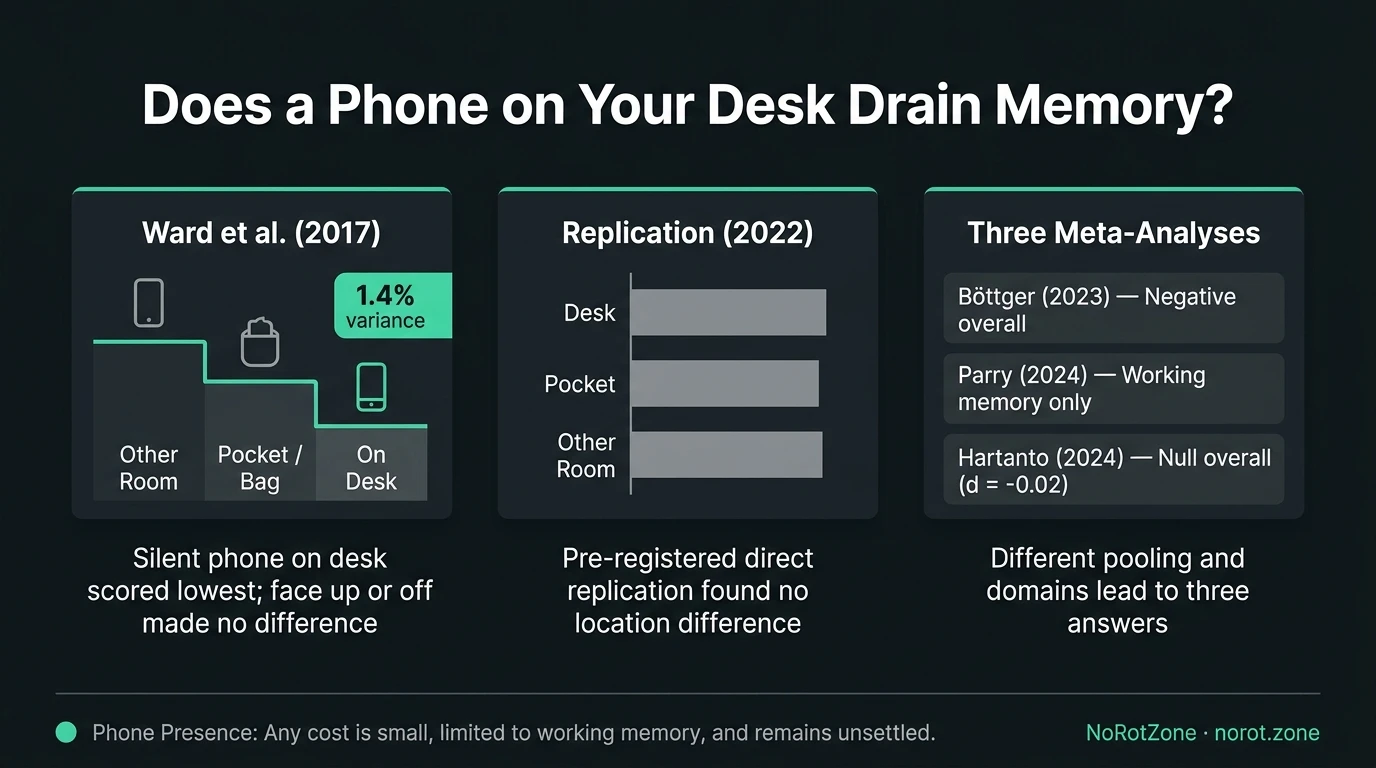
Ward’s team randomly assigned people to one of three phone locations. Scores followed that order, with the other-room group highest and the desk group lowest. Only the gap between those two ends was statistically reliable on the combined measure (p = .002). The pocket-or-bag group didn’t differ significantly from either.
The effect was small. Phone location explained about 1.4 percent of the variance in the working-memory scores.
A second experiment added three details.
- Switching the phone off made no difference.
- Face up versus face down made no difference.
- A sustained-attention task, where you respond to some targets and hold back on others, wasn’t affected by phone location at all.
The cost also showed up mainly in people who rated themselves as more dependent on their phones.
The proposed mechanism is that your brain spends effort not looking at something it badly wants to look at, leaving less for the task. The authors concede their data fit a second explanation equally well, that attention is quietly monitoring the phone. Their data can’t tell the two apart.
The follow-ups
Ruiz Pardo and Minda (2022) ran a pre-registered direct replication of Ward’s second experiment, using the same tasks and the same six conditions: phone on the desk, in a pocket or bag, or outside the room, each powered on or off. They found no difference between phone locations on either the working-memory task or the go/no-go task.
Hartmann and colleagues (2020) tested different tasks, short-term memory and prospective memory (remembering to do something later), and found no overall effect of phone presence on either. One moderator did appear: people with low phone dependence did better on prospective memory when the phone was absent, the opposite of what Ward’s team predicted about dependence. Because the tasks differed, this shows the effect doesn’t travel to other kinds of memory, not that the original failed.
Three meta-analyses, three answers
| Meta-analysis | What it pooled | Result |
|---|---|---|
| Böttger et al. (2023) | 22 studies, 43 effects, framed as smartphone use and presence | Significant overall negative effect, with differences between cognitive domains |
| Parry (2024) | k = 56, n = 7,093, six separate analyses | Working memory capacity impaired, other functions null, effect smaller than theorised |
| Hartanto et al. (2024) | 33 studies, 4,368 participants, 166 effect sizes | No significant overall effect (d = −0.02, 95% CI −0.06 to 0.01) |
A likely reason for the split is that they asked slightly different questions. Hartanto pooled every cognitive outcome into one estimate. Parry separated outcomes by domain and found a signal only in working memory. Böttger framed its question around smartphone use as well as presence. Parry also flags substantial methodological variation and generally poor statistical power across the literature, so none of the three is the last word.
Test your own focus. Focus Run drops distractions into your path while you hold a target. It won’t settle this debate, but it gives you a score for your own focus under pressure.
What this means for your desk
If the effect exists, it lives in working memory and it is small. The Hartanto team’s own reading is that there is not much reason yet to expect that cutting yourself off from your phone at work would improve productivity.
Putting the phone in another room costs nothing and removes the urge to pick it up, which is a separate problem. Our pieces on attention residue and grayscale mode cover it. Just don’t expect the room change itself to buy you extra mental capacity. In Ward’s own second experiment, face down and powered off did no better than a bare desk.
One 2017 experiment, one pre-registered replication that didn’t reproduce it, one follow-up on different memory tasks, and three meta-analyses that disagree add up to a single defensible position. If a silent phone costs you anything, it is small and limited to working memory. Anyone selling a lockbox on the strength of this literature is ahead of it.
FAQ
Where does the idea that a phone on your desk drains your brain come from?
A 2017 study by Ward and colleagues found students with phones on the desk scored lowest on working-memory and reasoning tests, and those with phones in another room scored highest. The effect was small, and a pre-registered replication of its second experiment did not reproduce it.
Does putting your phone face down or turning it off help?
In the original study neither changed the result: the location effect held whether the phone was face up or down, on or off. The contrast that mattered was desk versus another room, and that finding has not held up in a replication.
Should I keep my phone in another room while I study?
It costs nothing and removes the urge to check it. The evidence that the move itself improves memory or reasoning is weak, and a 2024 meta-analysis of 33 studies found no significant overall effect.
Sources
- StudyWard, A. F., Duke, K., Gneezy, A., & Bos, M. W. (2017). Brain drain: The mere presence of one's own smartphone reduces available cognitive capacity. Journal of the Association for Consumer Research, 2(2), 140–154.
- StudyRuiz Pardo, A. C., & Minda, J. P. (2022). Reexamining the "brain drain" effect: A replication of Ward et al. (2017). Acta Psychologica, 230, 103717.
- StudyHartmann, M., Martarelli, C. S., Reber, T. P., & Rothen, N. (2020). Does a smartphone on the desk drain our brain? No evidence of cognitive costs due to smartphone presence in a short-term and prospective memory task. Consciousness and Cognition, 86, 103033.
- StudyBöttger, T., Poschik, M., & Zierer, K. (2023). Does the brain drain effect really exist? A meta-analysis. Behavioral Sciences, 13(9), 751.
- StudyParry, D. A. (2024). Does the mere presence of a smartphone impact cognitive performance? A meta-analysis of the "brain drain effect". Media Psychology, 27(5), 737–762.
- StudyHartanto, A., Lua, V. Y. Q., Kasturiratna, K. T. A. S., Koh, P. S., Tng, G. Y. Q., Kaur, M., Quek, F. Y. X., Chia, J. L., & Majeed, N. M. (2024). The effect of mere presence of smartphone on cognitive functions: A four-level meta-analysis. Technology, Mind, and Behavior, 5(1), 1–14.
Keep Reading
Related Research
Predictable Timing Alone Sharpens Visual Detection, Oxford Study Finds
When events follow a predictable rhythm, the brain synchronizes sensory cortex to peak at the expected moment — making faint signals easier to detect.
Doomscroll Brain: What Short-Form Video Does to Your Attention
TikTok-style scrolling isn't just a habit — it's a measurable attention effect. Here's what the research actually shows.
What Is Brain Rot, Actually?
Oxford's 2024 Word of the Year — but is it real? Discover the actual cognitive studies and what the science says.
Key Takeaways
- A 2017 study of 520 students found those with phones on the desk scored lowest on working-memory and reasoning tests, but the effect was small.
- A pre-registered direct replication of the study's second experiment found no difference between phone locations.
- Three meta-analyses disagree: a negative effect overall, a working-memory-only effect, and no significant overall effect.
- Sustained attention and response inhibition were not impaired by phone presence in the original study or in the Parry (2024) analysis.
- If a silent phone costs anything, the cost is small and limited to working memory.
Ready to test it?
Focus Run drops distractions into your path while you hold a target, a quick check of your own focus under pressure.
Try Focus RunPublished November 25, 2026